Think you know swimming pools? Think again.
You see a rectangle of blue water.
Engineers see hydraulics.
Chemists see a balancing act.
Technology companies see an opportunity to build a robot that crawls around underwater cleaning your tile.
And history? Well, history has some truly strange things to say about swimming pools.
The modern swimming pool is a surprisingly complicated little world. It involves physics, chemistry, architecture, engineering, psychology, and enough equipment to make that innocent-looking patch of blue seem downright suspicious.
So grab your goggles.
We’re going deep.
1. Your Pool Is Basically a Giant Plumbing Experiment
Every time you swim, you’re floating inside a carefully engineered circulation system.
Water is pulled through skimmers and drains, pushed through pumps and filters, treated, and returned through strategically positioned jets.
The goal isn’t simply to “move the water.”
It’s to move it the right way.
A well-designed circulation system helps distribute treated water throughout the pool and prevents areas from becoming stagnant.
Your pool has traffic patterns. You just can’t see them.
2. Saltwater Pools Are Secretly Chlorine Factories
Here’s a fact that confuses plenty of pool owners:
Saltwater pools still use chlorine.
A salt chlorine generator uses electrolysis to convert salt into chlorine right inside the pool system.
So technically, your saltwater pool isn’t avoiding chlorine.
It’s making its own.
Your backyard has a tiny chlorine factory.
3. Ancient People Had Swimming Pools
Swimming pools aren’t exactly a modern invention.
Ancient civilizations created elaborate bathing and water features for recreation, exercise, socializing, and ritual purposes.
The Romans, in particular, turned bathing into a major part of public life, constructing enormous bath complexes complete with pools, heating systems, and sophisticated water infrastructure.
They didn’t have robotic pool cleaners.
They did have impressive plumbing.
Apparently, pool maintenance has been a thing for a very long time.
4. The Roman Empire Had Heated Pools
Speaking of the Romans: some Roman bath complexes used systems called hypocausts to heat buildings and water.
Hot air circulated beneath floors and through specially designed spaces, creating an early form of radiant heating.
Imagine explaining a modern pool heater to a Roman engineer.
Then imagine explaining Wi-Fi-controlled pool equipment.
They’d probably ask what Wi-Fi is.
Then they’d probably invent it.
5. Pool Water Can Be Surprisingly Old
Here’s something counterintuitive:
A properly maintained swimming pool doesn’t necessarily need to be completely drained and refilled every year.
With appropriate filtration, sanitation, chemical management, and occasional water replacement, pool water can remain in a pool for extended periods.
Your pool may have a longer memory than you do.
6. Your Pool Can Lose Water Without a Leak
Water disappearing from your pool doesn’t automatically mean you’ve sprung a leak.
Evaporation can remove surprisingly large amounts of water, particularly during hot, dry, windy weather.
Splash-out contributes, too.
And then there’s the mysterious phenomenon known as:
“Kids were swimming in it.”
That’s a scientifically significant variable.
7. Your Pool Cover Is an Evaporation Fighter
A pool cover isn’t merely there to keep leaves out.
A good cover can significantly reduce evaporation by creating a barrier between the water and the atmosphere.
That can mean less water loss and, depending on the pool and cover, reduced heat loss as well.
It’s basically a giant blanket for your water.
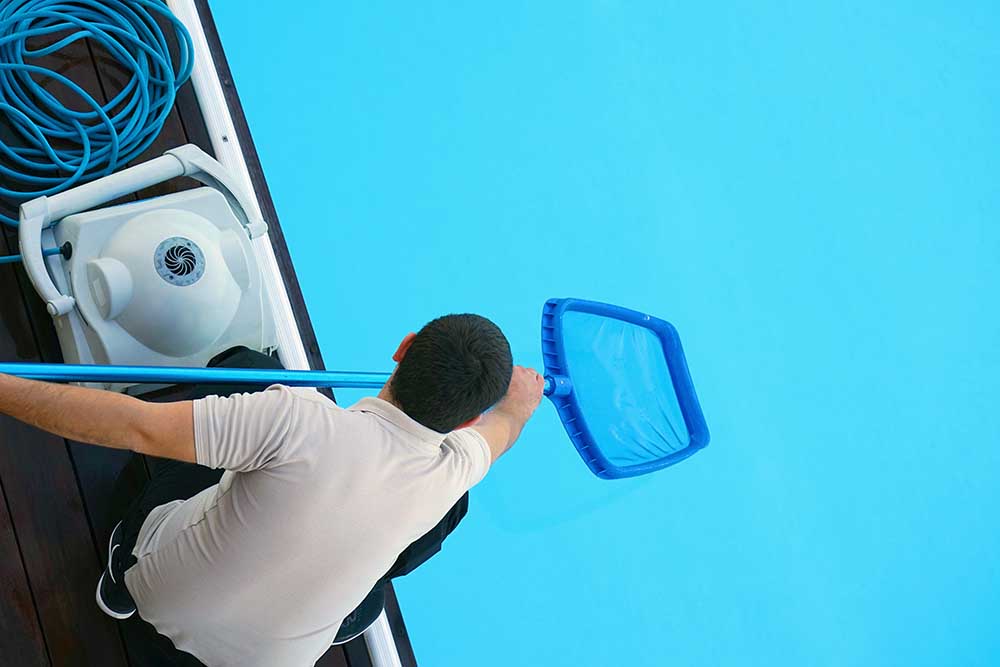
8. Some Pool Cleaners Can Climb Walls
Modern robotic pool cleaners aren’t content to stay on the floor.
Many models can climb pool walls, scrub surfaces, collect debris, and navigate around the pool with minimal human intervention.
Some can even clean the waterline.
Which raises an important question:
When exactly did pool cleaning become a robotics industry?
We don’t know.
We’re just glad the robots are useful.
9. Your Pool Filter Doesn’t Actually “Clean” Everything
A filter is fantastic at removing many particles from water.
But filtration and sanitation are different jobs.
The filter captures physical debris and particles.
Sanitizers help control microorganisms.
Water chemistry helps keep the environment stable and protect surfaces and equipment.
In other words, your pool doesn’t have one cleaning system.
It has a whole department.
10. Sand Filters Don’t Work Quite Like You Think
Despite the name, a sand filter doesn’t simply strain water through a pile of beach sand.
Pool filter sand is specially graded, and the filtration process involves water passing through the spaces between particles while contaminants become trapped.
Eventually, the filter needs cleaning through a process called backwashing, which reverses the normal flow of water to flush accumulated debris out.
Your filter occasionally needs to wash itself.
Very civilized.
11. The Pool “Smell” Isn’t Simply Chlorine
That distinctive indoor-pool smell people associate with chlorine can actually be influenced by chloramines, compounds that form when chlorine reacts with certain contaminants.
Proper pool chemistry and good circulation help manage these compounds.
So the classic “pool smell” isn’t necessarily evidence that a pool has an enormous amount of chlorine.
Sometimes your nose is detecting chemistry, not chlorine itself.
12. Your Pool’s pH Is a Balancing Act
Pool water needs to stay within an appropriate pH range.
Too low, and the water can become corrosive and potentially damage surfaces and equipment.
Too high, and sanitizer effectiveness can be reduced and scale can become more likely.
That tiny number on a test kit therefore has surprisingly large consequences.
One little number. A lot of responsibility.
13. Water Has a Memory… Sort Of
Water doesn’t literally remember anything.
But pool water can accumulate dissolved substances over time.
As water evaporates, the water leaves while many dissolved materials remain behind.
That means certain substances can become more concentrated unless they’re managed through dilution, treatment, or water replacement.
Your pool isn’t forgetful. It’s cumulative.
14. Depth Changes the Way Your Pool Looks
Ever notice that the same pool can look dramatically different at different depths?
Water absorbs and scatters light, and the pool’s interior finish, surrounding environment, sunlight, and viewing angle all affect the color you perceive.
A deep section can appear dramatically darker than a shallow section even though the water itself is the same.
Your pool is part swimming pool, part optical illusion.
15. Sunlight Is Both Friend and Foe
Sunlight makes a pool look spectacular.
It can also affect pool chemistry.
Ultraviolet light can break down unstabilized chlorine, which is one reason outdoor pools often use cyanuric acid as a stabilizer.
So while you’re soaking up the sunshine, your chlorine may be getting a very different experience.
You’re getting a tan. Your chlorine is getting destroyed.
16. A Pool Pump Doesn’t Always Need to Run at Full Speed
Variable-speed pumps can operate at different speeds rather than running continuously at one fixed high speed.
That matters because pump energy consumption can change dramatically with operating speed.
A pool can therefore be designed and managed around different circulation needs rather than treating every hour of operation like a race.
Your pump doesn’t need to floor it everywhere it goes.
17. Olympic Pools Are Seriously Big
An Olympic-size swimming pool is roughly 50 meters long and 25 meters wide, with dimensions and specifications governed by competition standards.
That’s a lot of swimming.
And a lot of water.
And an absolutely unreasonable amount of skimming.
Your backyard pool suddenly looks adorable.
18. Pool Water Can Be Heavy Enough to Make Engineering Interesting
Water weighs about 8.34 pounds per U.S. gallon.
That means even a relatively modest residential pool contains tens of thousands of pounds of water.
Put another way:
Your pool isn’t just wet. It’s extremely heavy.
This is one reason pool construction, drainage, structural design, and surrounding soil conditions matter so much.
19. Indoor Pools Can Actually Affect Buildings
Indoor pools create warm, humid environments.
Without appropriate ventilation and humidity control, moisture can condense on surfaces and potentially contribute to corrosion, material deterioration, or building damage.
That’s why a beautiful indoor pool requires more than a heater and a bucket of chlorine.
Sometimes the biggest pool problem isn’t in the pool. It’s above it.
20. Your Pool Is Never Really “Doing Nothing”
Even when nobody is swimming, your pool may still be circulating, filtering, sanitizing, heating, losing water to evaporation, collecting debris, and interacting with the environment.
It’s a constantly changing system.
Which is why professional pool care isn’t just about making the water look pretty.
It’s about keeping all those moving parts working together.
The pool may look still. Underneath, it’s anything but.
The Deep End of Pool Trivia
The next time you sit beside a swimming pool, take a second look.
That shimmering rectangle isn’t just water.
It’s a miniature engineering project.
It’s chemistry in action.
It’s hydraulics, filtration, physics, temperature, light, and technology—all quietly working together while you float around on an inflatable flamingo.
And perhaps that’s the strangest thing about modern pools:
The more you learn about them, the less “simple” they look.
So enjoy the water.
Admire the sparkle.
And the next time somebody says, “It’s just a swimming pool,” you can smile knowingly.
Because now you know better.
…There’s a whole weird world hiding beneath the surface!
Next spring… for a sparkling pool all summer long, give us a shout… we’ve got you UNcovered!